The weather was cooperative for this, our toughest day hiking the Long Trail. We started early and made our way through Devil’s Gulch, a narrow passage through two rock walls, littered with jagged car-sized boulders. Past the gulch, the trail rose and fell for 3 km to reach the road at Eden Crossing. It was here that the real climbing began. Belvidere Mountain is 1024 m up, 600 m higher than Eden Crossing. Fortunately, the trail follows a creek that spirals down the mountain. Unfortunately, the trail became a secondary creek thanks to the earlier rain so our progress was slow.

Anthony
Anthony, from southern Vermont, was on day three of his SOBO thruhike of the Long Trail. He hadn’t met many hikers yet so he hadn’t gained a trail name. You could say he was on a long walk home.
We stopped for lunch at the fire tower atop Belvidere Mountain. From the peak, there was a limited view to the south and east. The fire tower offered a 360 degree view but the strong winds stopped my climb half way up. George and Rob made it to the top of the tower for a quick look before scurrying back down.
From Belvidere, the trail follows the ridgeline to Tillotson Peak. The trail is difficult, requiring one’s full attention to find good footing. It didn’t give up many good views along the way.
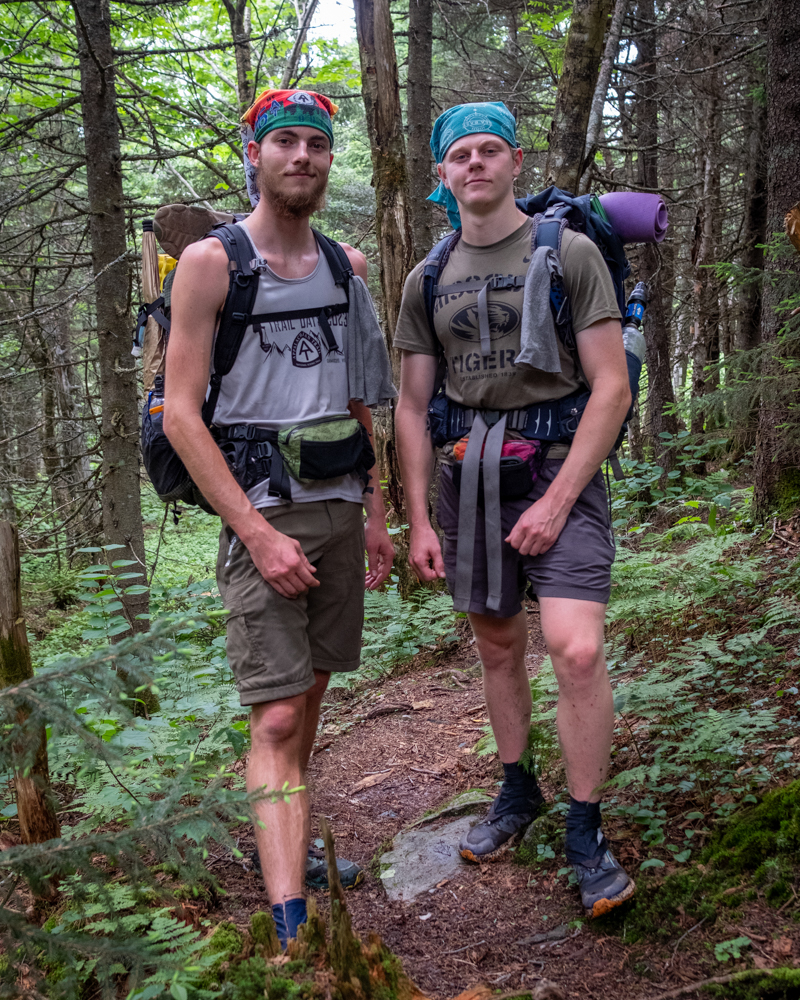
John Deere and Dubage
John Deere and Dubage, friends from Missouri were on day 4 of a SOBO thruhike of the Long Trail. Last year John Deere thruhiked the Appalachian Trail. This year Dubage joined John Deere on a second Appalachian Trail hike, but got talked into trying the Long Trail instead. They were taking their time on this challenging trail, enjoying the “good vibes” so far.
We reached Tillotson Camp late in the afternoon, washed up, and settled in. Tillotson Camp, at one time, had a great view across the valley, but it was now obscured by young trees. Someone had attempted to reclaim the view with a rusty carpenter’s saw, leaving a pile of tree tops with wilted leaves, and no improvement to the view. The cabin was small, and dark, holding a maximum eight hikers in four cozy bunks. This night we each got our own bunk. Part of the front wall dropped down as a cooking platform during the day, allowing more light in.
After dinner when the mosquitoes came out, we closed the wall, turned on our headlamps, and played some Farkle. We quickly realized that more mice than people lived in the cabin. Previous shelters all had pieces of rope with inverted pop cans hanging from the ceilings used for protecting food bags from rodents. This cabin had none. It became clear to us that the foul smelling metal box placed behind the cabin was necessary to protect our food. Previous hikers had left food and garbage in the box. It was wet and smelled terrible. We used the carpenter’s saw to cut some planks to make a platform in the box for our food. Once loaded up, we weighted the lid with rocks to keep the mice and rain out. Mice scurried about all night in the cabin, but our food was untouched in the box.